Nothing can put the brakes on a holiday quite like a breakdown. One minute you’re singing along to the radio, heading for your destination; the next, you’re stuck at the side of the road longing for a cold drink and a quick fix.
Whether you’re renting a car or travelling in your own vehicle, the steps below outline how you can reduce the risk of a breakdown in Europe and make good decisions if it does happen.
Reducing the risk of a breakdown when driving in Europe
Minimising the risk of a breakdown is a good place to start. A little preparation and some routine checks before you set off on your European trip can make all the difference.
- Check your tyres are inflated properly and above the legal minimum tread depth.
- Test that your brakes and lights are working as they should.
- Make sure your coolant and engine oil levels are optimal.
- In the lead-up to your trip, making sure your vehicle is up to date with its servicing schedule can bring peace of mind, too.
This is also a good time to check the specific regulations for the destination you’re travelling to. For example, some cities may require you to display specific emissions stickers, while some countries require you to carry certain items in your car.
| General European driving advice | Guide to driving in Germany | Guide to driving in France | Guide to driving in Spain |
Emergency kit to bring with you
Continuing with preparation, if you do break down, the following items are helpful to carry for safety, logistics, and visibility purposes.
- A warning triangle (not for use on motorways)
- A hi-vis jacket for yourself and one for every passenger on board
- Passport, driving licence, insurance, breakdown cover details, and any rental car information.
What happens if I break down in Europe?
If your car breaks down in Europe, you’ll need to alert other drivers, pull over to a safe stopping point, exit the vehicle (if safe), and call for help.
While the immediate steps are very similar to what happens if you’ve broken down in the UK, who you call and the next stages (like repatriation, roadside assistance, and repair) all depend on the road you’ve broken down on, and whether you have European Breakdown Cover.
Immediate steps to take
- Turn on your hazard lights immediately.
- Try and pull over to a safe stopping place. Depending on the road type, this may be the side of the road, the hard shoulder (if in an absolute emergency), or a designated breakdown bay.
- Make sure you and your passengers are wearing hi-vis jackets, especially in low-light or foggy conditions.
- If it is safe for you to do so, exit the car via the doors furthest from oncoming traffic. This may mean climbing across the seats in your car.
- Direct your passengers to a safe place behind the barrier, standing back from the roadside.
- Take any essential items (passport, driving licence, breakdown cover documents) with you.
- If you’re not on a motorway, place your warning triangle at least 45 metres behind your vehicle.
Calling for assistance & repairing your car
If you have European Breakdown Cover
Check your location
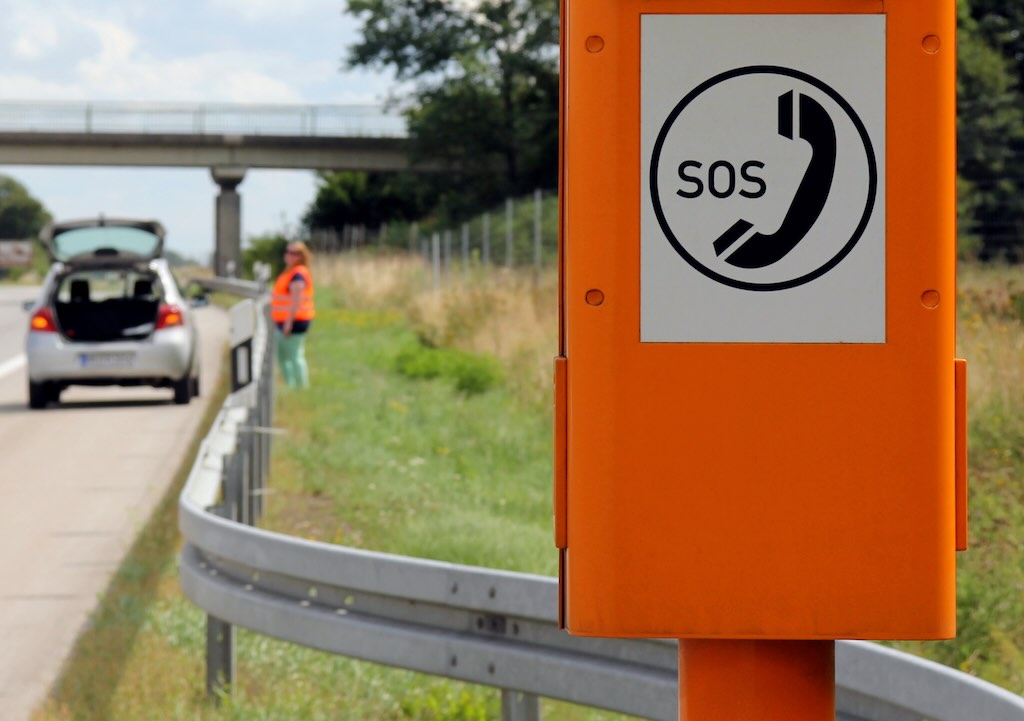
On European motorways and toll roads (like in France, Italy, and Belgium), if you break down you must dial 112 or use a roadside SOS box. From here, local authorities and approved recovery operators will tow your car to a safe zone.
On standard roads, skip to the next step.
Get in touch with your breakdown provider
Once you’re in a safe spot, call your UK provider’s European helpline. Have your policy number, vehicle details, and location handy.
Pay and reclaim
If the local authorities charge you on the spot for a motorway tow, pay by card and keep your receipt. You’ll probably be able to claim this back from your provider later.
Repairs & next steps
If a garage needs a specific part to fix your car and they can’t source it locally, your breakdown provider may be able to track down the spare part elsewhere and have it sent to the garage.
Getting the car back to the UK
If your car can’t be fixed by the time you’re scheduled to travel home, your breakdown provider would usually arrange and handle the repatriation to transport you, your passengers, and your vehicle back to the UK safely (depending on your cover level and policy limits).
If you don’t have European Breakdown Cover
Call 112 straight away
Dial 112 from wherever you are or use one of the roadside SOS boxes. The local police or emergency services will coordinate with a local garage to come and rescue your vehicle.
Await local recovery
Keep communication open with the local recovery operator sent by the 112 team. Make sure you find out exactly which local garage your vehicle is being taken to.
Cover the costs on the spot
You’ll need to pay the local authority or recovery garage directly using a debit or credit card. Because you’re travelling without cover, these out-of-pocket costs can’t be claimed back.
Arrange repairs
You may have to locate your own replacement parts if the garage doesn’t have them and can’t get hold of them, negotiating with the foreign garage, and overcoming any language barriers to get the repairs authorised and completed out of your own pocket.
Arrange for repatriation
If your car is completely out of action, you’ll have to independently hire a private international shipping or towing company to bring your car back across the channel.
What to do if you break down on a motorway in Europe?
Motorway breakdowns are treated differently: there’s faster-moving traffic and more lanes, making roadside assistance slightly trickier, and safety procedures even more important.
Things to note:
- Some European motorways are managed privately, meaning drivers who have broken down must use an emergency roadside phone or call 112 on their own phones to arrange recovery.
- Certain European roads (like the German Autobahn) have much higher speed limits and treat breakdowns as a major hazard. In these situations, you should try to pull into a breakdown bay and call for assistance using 112 or an emergency phone.
Stay safe on your travels
Preparing your car, knowing the rules of the roads you’ll be travelling on, and understanding exactly what to do should you break down are all excellent ways to take the sting out of a holiday breakdown. For more advice for driving abroad, keep up with the Green Flag blog.