If your car stops at the side of the road, the most important thing is knowing what to do next. Breakdowns aren’t something anyone plans for, but there are clear, practical steps you can take to protect yourself and your passengers.
Staying calm and focusing on those steps can help you feel more in control. From positioning your vehicle safely to contacting the right help, small actions can make a big difference.
This guide walks you through what to do; so if it does happen, you’ll feel better prepared to deal with it safely and confidently.
What should you do if your vehicle breaks down on a busy road?
If your vehicle has stopped on a busy road, you should:
- Move your vehicle as far to the left as possible and turn your wheels away from the road.
- Switch on your hazard warning lights immediately and use sidelights if it’s dark or foggy.
- Get out of the vehicle through the doors furthest away from the traffic, or remain inside with seatbelts fastened if that’s not possible.
- Stay well-behind the safety barrier, while keeping children and pets under close control.
Contact your breakdown provider or the emergency services once you’re in a safe location.
1. Position your car for safety
If your vehicle is slowing down before stopping, aim to move it as far to the left as possible, ideally into an emergency area, or onto the hard shoulder. Once stopped, turn your front wheels to the left. This helps prevent the vehicle from being pushed back into traffic if it’s hit from behind.
2. Visibility is a top priority
Once your vehicle has stopped and is positioned correctly, making it easy to spot is essential, especially in low-visibility conditions.
- Immediately turn on your hazard warning lights to signal to other drivers that you’re having a problem.
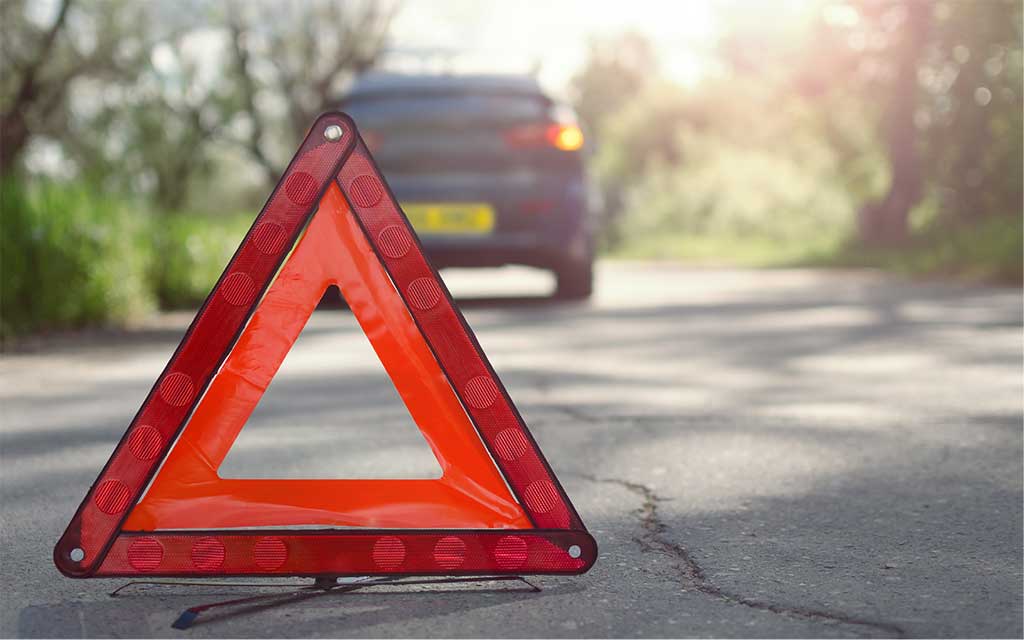
- Place a warning triangle at least 45 metres behind your vehicle on quieter roads, only where it’s safe to do so.
- Crucially, you should never place a warning triangle on a motorway, as this road type is too dangerous for pedestrians.
How to stay safe after a breakdown at night
Low-visibility breakdowns require extra caution. If it’s dark, foggy, or raining, you should keep your sidelights switched on (as well as your hazard lights) to make sure your car remains visible from a distance. When getting out of your vehicle, you and other passengers should wear high-visibility jackets (if you have them) to help other drivers see you more clearly.
3. Get out of your car away from traffic
A stationary object on the road can distract other drivers and pose a collision risk. This means that, if it’s safe to do so, it’s usually better to move away from your car.
Once everyone is wearing any available high-visibility clothing, you should:
- Get out of your vehicle through the doors furthest from moving traffic; this is typically the passenger side in the UK. If needed, carefully climb across the seats rather than stepping into the path of traffic.
- Move to a safe spot behind the roadside barrier. Position yourself a few car lengths further up the verge, facing oncoming traffic. This allows you to see approaching traffic and keeps you away from danger should your car be hit.
- If you have to remain in your vehicle, wear seatbelts.
There may be situations where it isn’t safe or practical to leave your vehicle. This may be because:
- You can’t safely reach the hard shoulder and are in a live lane
- There is no barrier or safe area to move to
- You have vulnerable passengers or passengers with mobility issues who are unable to get out safely
- Conditions like poor visibility make leaving the vehicle unsafe
If this happens, stay inside with your seatbelts fastened and call 999 straight away. Explain your location clearly and follow the operator’s instructions while you wait for assistance.
5. Don’t get back in your vehicle
It may be cold, raining or windy, but you should never get back into your car once you’ve reached safety. If you’ve moved behind a barrier, stay there while you wait for help and avoid going back to your car to collect items. Staying in one safe place, well clear of traffic, reduces unnecessary risk while you wait for help.
6. Know your location
It’s easy to lose track of exactly where you are, but being able to provide an accurate location to emergency or recovery services is crucial.
What to do:
- Look for the small blue or white marker posts on the roadside, which provide specific location codes for emergency services.
- Use tools like What3Words to provide recovery services with a precise three-metre-square location. Make sure you get to safety before using your mobile phone.
7. Call for help as soon as you’re safe
As soon as you and your passengers are in a safe place – either behind a barrier or secured inside the vehicle – contact your breakdown provider or, if necessary, the emergency services.
Making the call promptly means support can be arranged without delay. Even if the issue seems minor, it’s better to have assistance on the way rather than waiting to see if the vehicle will restart.
8. Avoid DIY repairs on fast roads
If you’re on a busy road, don’t be tempted to try to fix your car while waiting for the recovery or emergency services to arrive. The hard shoulder or roadside isn’t a suitable place to lift the bonnet or carry out checks. Recovery operators are trained and equipped to work safely in these conditions: staying clear and waiting in a safe place helps reduce unnecessary risk while help is on the way.
9. Keep passengers calm and under control
For children and pets in particular, breakdowns can be scary experiences. Make sure all passengers stay well away from the road and behind the safety barrier. You should never allow pets to run free, even if they seem stressed.
10. Use your safety gear
When your vehicle stops unexpectedly, having the right equipment can make things easier. It’s worth carrying:
- A First Aid kit
- A warning triangle
- High-vis jackets
- A fully-charged power bank and cable for your phone
- Some water and snacks
- A warm, waterproof layer or umbrella
- Jump leads
- A basic car tool kit
For a detailed explanatory list, see our blog on essential things to carry in your vehicle.
Be prepared before you travel
Breakdowns are never planned, but a little preparation can make a big difference. Knowing the basic safety steps and keeping a few essential items in your car can help you deal with the situation more confidently if it does happen.
Before setting off, it’s also worth checking that you have breakdown cover in place. That way, if your vehicle stops unexpectedly, you can arrange assistance quickly – and focus on keeping yourself and your passengers safe while help is on the way.
Location is definitely important–thanks for pointing that out! You might call the best roadside service in the world, but if they don’t know where you are it’s not going to matter. That’s a lesson I learned from personal experience. It’s important to always pay attention to where you are when you’re driving (which seems obvious, since you don’t want to get lost). You’ll be safer in the long run.
Not only standing on the far side of the motorway barrier for safety after a breakdown, all occupants should be several metres back up the motorway in case their vehicle is struck by a passing vehicles